
For Students
Your hub for everything you need to complete your senior partner interviews and document their stories.
Student participants use this page as their central hub for interviews, resources, and guidance throughout the Youth Senior Connections program.
Use the platform to document and share the life story of your senior partner.
Quick Tips

Include Rich Details
Add specific facts and memories to make the story vivid — use phrases or bullet points, not complete sentences.
Watch Your Spelling
Double-check names, family members, friends, schools, streets, and employers. Accuracy matters for the story.

Save Your Work
Always save after completing a section or at the end of each meeting. This keeps the story secure — very important!
Student Questions
Include enough specific small details to make the story come alive but avoid using complete sentences.
Yes! You can always go back to a section and make corrections. Just remember to save your work again after editing to make sure all changes are recorded.
It’s okay if they don’t know or don’t want to answer a question. Skip the question and move on, or gently ask a related question to capture what they can share.
Take your time during each visit to listen carefully and capture meaningful details — quality is more important than rushing. At the same time, remember that we have a limited number of visits, so try to cover as much of your senior partner’s story as possible. Your goal is to gather enough stories and memories to create a complete LifeBook they’ll cherish.
This program is designed to help you build skills that matter beyond the classroom. Through real conversations with older adult partners, you’ll practice communicating clearly, listening thoughtfully, and adjusting your questions based on who you’re talking to.
You’ll also build confidence by working with a real audience. Interviewing and documenting life stories helps you understand the importance of empathy, respect, and curiosity, while strengthening your writing and reflection skills. These experiences support social-emotional growth, career readiness, and your ability to communicate effectively in school, at work, and in everyday life.
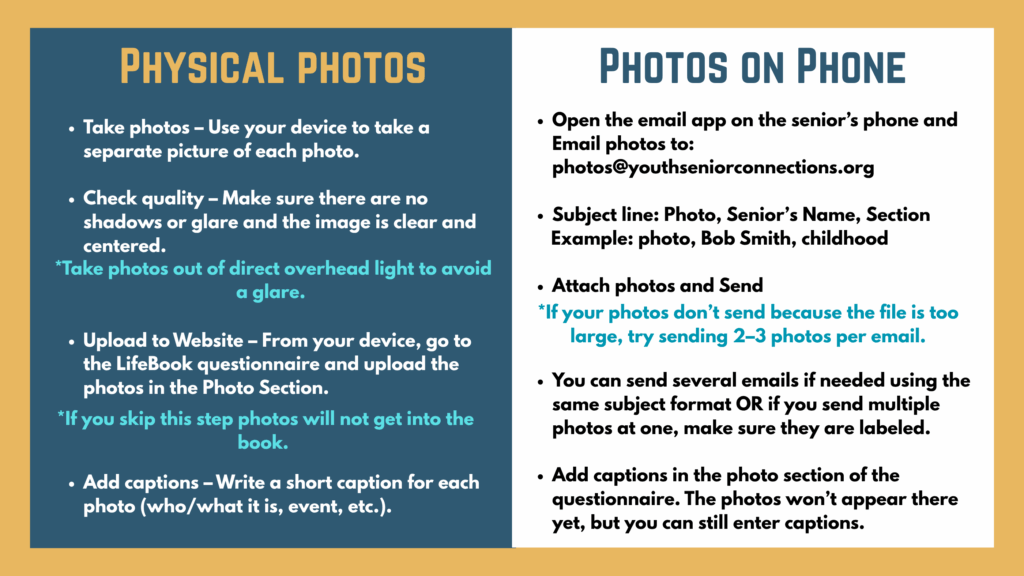
How-To Upload Photos
How To Fact Check a Life Story
- Read Aloud and Check for Accuracy – Focus on names, dates, places, relationships and complete details.
- Don't Delete – Clarify Instead – Make corrections in the document to keep the story intact.
- Reread and Review – Do a final check for accuracy, consistency and polish.

Stop Pretending to Listen: 4 Tips That Work
- Commit & Focus – Make the conversation a priority. Relax, breathe, and give your full attention.
- Use Non-Verbal Cues – Show you’re listening with eye contact, nods, and paying attention to their body language.
- Engage Verbally – Ask questions, use small responses like “yeah” or “I hear you,” and really listen before replying.
- Keep the Focus on Them – Let them talk and reflect or ask follow-ups to show you understand.